
External Latch Lock Reliably Controls Mold Plate Sequencing
The DME EZ-LATCH patent-pending lock design provides a long-lasting, more reliable easy-to-install lock for plate sequencing.


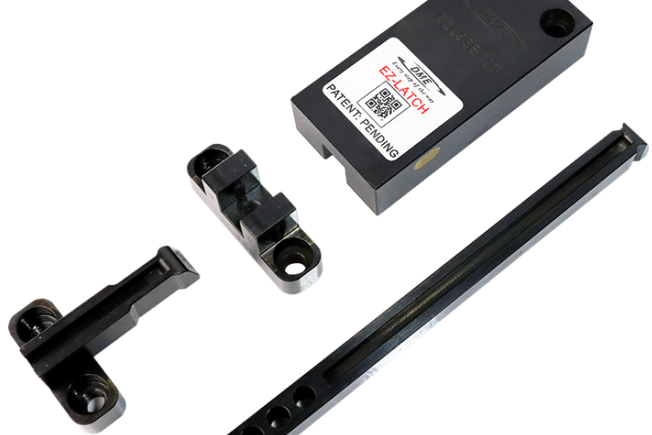
Photo Credit: DME Company
DME has released a new external latch lock, the EZ-LATCH, which reportedly provides customers long-lasting, more reliable functionality for plate sequencing.


External latch locks are commonly used in a range of different mold designs requiring plate control, including molds with three-plate sequencing, two-stage ejection, early return systems and a moving (core) and stationary side (cavity) ejection application. DME notes that, while springs or friction devices are normally in place to trigger the locking mechanism, they are prone to failure over time, and often require custom manufacturing to meet the specific application needs.
Alternately, the patent-pending DME EZ-LATCH strengthens the external latch lock system for a safer, more reliable method of controlling plates. Further, with its novel design and easy installation, DME says that, depending on the application, the system can be an alternative to more expensive hydraulic cylinders used for sequencing plates.
Unlike traditional external locks which need to be vertically mounted, DME reports that the EZ-LATCH Lock can be installed horizontally, enabling its use on plates as thin as 7/8”. Further, the DME EZ-LATCH lock needs no machining modifications and requires only the selection of the appropriate body and latch bar lengths.
The system comes in multiple lengths to sequence the plates and deliver perfect timing. EZ-LATCH is available in many latch bar lengths covering the widest range of stroke requirements. A long latch bar version providing longer delayed ejection is also available. DME notes that standard sizes accommodate most, if not all mold base sizes and applications; however, DME also provides special sizes available upon request by contacting: dme_mech_eng@dme.net.
Related Content
-
Physics of Side Actions: An Introduction to Elasticity and Thermal Expansion
Material elasticity and thermal expansion critically determine mold design performance and troubleshooting effectiveness.
-
Strategic Mold Cooling – Hot Spots
With complex plastic parts it can be difficult to deliver proper cooling to all potential hot spots. Here are strategies to help cool some difficult-to-cool areas.
-
How to Solve Core Pull Flash and Part Issues
Many mold problems can be solved by simply providing enough preload force on the core to prevent movement.


