
Rebuilding Tools with High Performance Material
High-performance alloy offers a unique combination of thermal conductivity and strength—providing numerous benefits to the moldmaker and molding process.


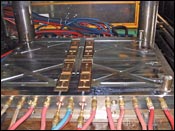
After being retooled with MoldMAX®, this four-cavity Fly Box leg mold is experiencing a dramatic decrease in cycle time, from 80 seconds to 46 seconds. Photos courtesy of Brush Wellman.
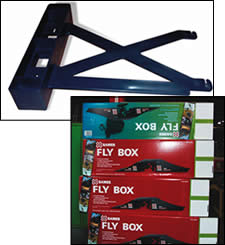
Productivity increased 50 percent after retooling with MoldMAX. Where First Plastics was producing 1,000 finished units per week they are now producing 1,500 in the same time.
MoldMAX, a high-performance alloy from Brush Wellman Inc. (Cleveland, OH), provides a unique combination of thermal conductivity and strength that yields important benefits for molders and the molding process. This high thermal conductivity results in shorter cycle times as the mold heats to operating temperature faster. Once the plastic is injected, it is able to reach a uniform temperature more quickly than with steel tools. This uniform cooling results in better part quality, decreased warping and greater part strength.
Without uniform cooling a number of concerns arise. Among them, resin characteristics are not maximized and the part does not have the level of ductility or rigidity necessary; stress is added to the material that causes the part to break or fail in the application; and, high temperature concentrations in ribbed areas and support structures cause part distortion as it cools outside the mold. Temperature concentrations cause gases to form in the mold due to the combination of heat, chemical composition of the resin and condensation. This can cause porosity in the plastic, degradation of the resin (causing it to discolor and not set up correctly), and corrosion to the core/cavity surface of the mold.


MoldMAX allows moldmakers to provide their customers with an alternative solution, which can lead to increased profitability through better machinability, cycle time reduction and part quality.
X Games Fly Box
Just as extreme athletes often seek faster speeds, the company that manufactures the popular X Games Fly Box skate/bike ramp sought faster cycles in molding the toy’s plastic components.
The Fly Box, manufactured by custom plastic injection molder, First Plastics Corp. (Leominster, MA) features two facing ramps supported by a middle tabletop. Assembled, it measures 24" wide by 96" long by 18" high.
According to First Plastics’ president, Ed Mazzaferro, F & M Tool (Leominster, MA) built a total of six tools for this project. These tools were made from P-20 steel. While the finished plastic pieces that were being produced were acceptable for use on the Fly Box, the surfaces showed signs of warping, which left a bumpy surface that was unattractive.
The surface of the table also had imperfections and the rib section on the underside caused distortion to the top. F & M rebuilt the single cavity tool for the 24" x 24" x 3" tabletop using MoldMAX LH®, which is specially designed for the plastic processing industry.
“This improved the look of the tabletop and eliminated the distortion. Cycle times were also reduced from 67 seconds to 40 seconds,” says Mazzaferro.
First Plastics was so pleased with the results of the MoldMAX part for the table, they decided to also rebuild the tools for the leg section using it. The leg mold has four cavities. The new MoldMAX part has nearly cut the cycle time in half, from 80 seconds to 46.
According to Mazzaferro, prior to retooling his company produced 1,000 finished units per week. Now due to these reductions in cycle time, they are producing 1,500 finished units each week—a 50 percent increase in productivity.
The company is eager to repeat these positive results and plans are currently underway to rebuild the ramp tools for even greater speed and efficiency.
|
High-Performance Alloy Designed for Plastic Processing MoldMAX copper mold alloys provide shorter cycle time, improved plastic part dimensional control, better parting line maintenance and excellent corrosion resistance. They provide strength and wear resistance similar to that of many tool steels. In addition, they offer a thermal conductivity up to 10 times greater than steel. It is typically specified for injection mold components and core/cavity inserts; blow mold pinch offs, neck rings and handle inserts; and, hot runner system injection nozzles and manifolds.
MoldMAX LH® (Low Hard) is a premium copper mold alloy that provides hardness and strength comparable with standard AISI P-20 tool steel and a thermal conductivity five times higher. It is used for injection mold cores and cavities where moderate hardness and high toughness and conductivity are required.
|
||||||||||||||||||||||||||||||||||||||||||


Related Content

What You Should Know About Injection Mold Safety Straps
Every mold should have one in order to be safe and OSHA compliant.
Read More
Precision Meets Innovation at IMTS 2024
After attending IMTS, it's clear that the integration of advanced technologies is ready to enhance precision, efficiency and automation in mold manufacturing processes. It’s a massive event, so here’s a glimpse of what the MMT team experienced firsthand.
Read More
What Is Scientific Maintenance? Part 2
Part two of this three-part series explains specific data that toolrooms must collect, analyze and use to truly advance to a scientific maintenance culture where you can measure real data and drive decisions.
Read More
Understanding Manifold Thermal Expansion
Molders, mold builders and repair technicians must fully understand thermal expansion to ensure they don’t damage critical seals during manifold repairs or routine cleanings.
Read MoreRead Next

Fast, Accurate Reverse Engineering Created Improved Product
A 3-D laser scanning project involving reverse engineering a blow molded bottle when no CAD data was available.
Read More
Your Guide to Smarter, Faster Mold Design
Dive into expert-curated content delivering proven solutions for mold optimization, manufacturability and precision performance.
Read More
Overcoming Pain Points in Moldmaking with AI
Shops that embrace AI as a tool, not a threat, can enhance efficiency, preserve expertise, and attract tech-savvy talent.
Read More