
Forty to 200 Percent ROI on Training
Strategies for attacking the lack of ongoing training dilemma that directly impacts our shops.
Share

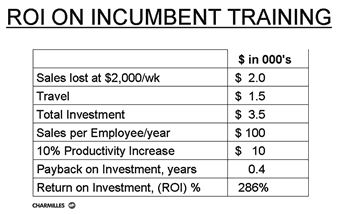
Figure 2.
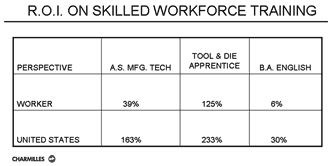
Figure 1. Figures courtesy of Charmilles Mikron.
Manufacturing employment is static or declining. Manufacturing has partially recovered from the severe recession of 2002/2003, but the U.S. is still perceived as having a post industrial economy. Partially because of this perception, there are, once again, severe shortages of skilled technicians across a broad range of manufacturing processes and technologies.
The Problem
NAM’s (National Association of Manufacturers) recent survey with Deloitte Consulting LLP showed that 90 percent of U.S. manufacturers face “moderate” or “severe” shortages of skilled production employees, in comparison to 18 percent for sales and marketing and 16 percent for management and administration. These results are confirmed by the Charmilles/NTMA August/September 2005 survey of NTMA (National Tooling & Machining Association) members.
With a 25 percent response rate, the survey showed that shops wanted to hire sufficient skilled workers to add on average, 4.7 percent to their existing workforce. The average starting wage would be $16.34/hour. At the same time that we have a shortage of skilled manufacturers, we have excesses of workers with four-year liberal arts degrees.
According to the Bureau of Labor Statistics, of all workers with four-year degrees, at almost any point in the economic cycle, approximately 20 percent are in jobs that do not require a college degree and are making less than the median income for high school graduates. Clearly, our society produces far too many university graduates with liberal arts degrees and nowhere near enough skilled manufacturers.
The Impact
The impact on our country and the workers who make the wrong education and career choices is dramatic. The ROI (Return on Investment) on skilled workforce training from the perspective of the worker and of our country is shown in Figure 1, which compares the ROI on an associate's degree in manufacturing technology or a tool and die apprenticeship to that on a bachelor’s in English.
From the perspective of the worker and of our country, the ROI on the English degree is absolutely and comparatively low. When accumulated across the hundreds of thousands of liberal arts degrees awarded annually, it is no surprise that the competitiveness of our country continues to decline.
The lack of ongoing training directly impacts our companies. Figure 2 shows the ROI on incumbent training. We estimate that 30 to 50 percent of precision machinists have never been trained by the manufacturer of the machine tool that they operate. We estimate that one week of training will yield a 10 percent productivity improvement and an ROI that approaches 300 percent annually. Despite this payback, companies tend to rely on hand-me-down training instead of going back to the source.
Some Solutions
Here are some things we can do about the problem:
- Promote manufacturing careers. Use the promotional material from NTMA, TMA, AMBA, PMA and Charmilles found at www.charmillesus.com/company/careers.cfm. Some examples of data to promote include an analysis of the impact on the Pennsylvania economy of the shortage of toolmakers, a calculation that shows that the median tool and die maker could expect to have one million dollars more net worth at the age of 49 than the median holder of a bachelor’s degree in English and the Career Opportunities Chart, which favorably compares median incomes for precision machinists or tool-makers versus holders of master’s and other university degrees.
- Maintain the highest levels of shop housekeeping, safety and training. The historic image of greasy, noisy manufacturing certainly has hurt our recruiting opportunities.
- Have your workers trained by the equipment supplier. Choose equipment suppliers that provide the best training
(such as training aid that can be utilized onboard the machines’ PC control or offline to assist the operator in machine programming). - Encourage your elected representatives to shift resources from training unneeded liberal arts graduates to training the technicians and engineers whose shortage is hurting our companies and the U.S. economy. For example, it would make sense for government educational loans to offer preferential rates or availability to the degree fields in which we have shortages, rather than to fields in which we already have huge surpluses of workers.
An exchange of information regarding this field covering strategies and trends concerning incumbent worker training, NIMS credentials, the current skilled workforce shortage, future workforce and best practices for recruiting with Chuck Arnold of Battlebots IQ; Paul Koontz of Formula 1; James A. Wall of National Institute for Metalworking Skills; and, Harry Moser of Charmilles Mikron will be presented during the Education/Training Panel Discussion at the MoldMaking Expo 2006.


Related Content

How To Get Buy-In from Your Team for ISO 9001
Here are four tips for getting your team on board once you’ve decided to become ISO 9001 certified.
Read More
What You Should Consider When Purchasing Modified P20 Steel
When buying P20 steels that have been modified, moldmakers must be aware of the variations and key issues that affect delivery, cost and lead times.
Read More
Sybridge Technologies' Operations Manager Shares Three Favorite Articles: Purchasing, Transfer Tooling, Scientific Molding
MMT's Editorial Advisory Board shares its top MoldMaking Technology articles of all time and how this content has been valuable to their businesses.
Read More
Resilience and Reflections: Moldmaking in the Evolving Economic Landscape
As moldmakers navigate this complex year marked by fluctuating business activities, and approach the upcoming year with cautious optimism, three key considerations should guide their decisions.
Read MoreRead Next

Reasons to Use Fiber Lasers for Mold Cleaning
Fiber lasers offer a simplicity, speed, control and portability, minimizing mold cleaning risks.
Read More