
Custom Moldmaking Process Technology Slashes Processing Time and Costs
A breakthrough molding technology has been developed that delivers considerable time reductions and cost savings for fabricators of parts constructed from composite materials.


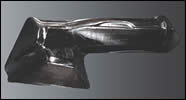
Stage 3. The final result is a composite graphite base.
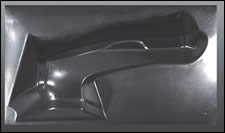
Stage 2. The CMPT process creates a forming tool.
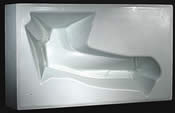
Stage 1. The customer provides the master model. Images courtesy of General Magnaplate Corp.
A breakthrough molding technology has been developed that delivers considerable time reductions and cost savings for fabricators of parts constructed from composite materials.
Custom Moldmaking Process Technology (CMPT)®, devel-oped by General Magnaplate Corp. (Linden, NJ)—a specialty coatings manufacturer—reduces the total time needed to make large, all-metal lay-up molds for complex reinforced composites from the current six- to 12-month period to as little as six weeks. It also slashes tooling capital investment by one-third, notes Edmund Aversenti, General Magnaplate’s Chief Operating Officer. “Tools manufactured with this process reproduce fine pattern detail—with dimensional stability—and the process is consistent with traditional EDM finished tooling,” Aversenti states. “It represents a quantum leap in the composite fabrication industry—making it possible to drastically lower the final cost for many molded, complex-shaped parts, especially those with contours. Such contoured composite parts are used in applications as diverse as Stealth bombers and refrigerator doors.”
How It Works
The process itself is a dense, multi-directional, all-metal-weaving process, which eliminates the need to machine layup-molds out of large, heavy metal ingots or castings that require so much time to fabricate. “The tool is made by robotically weaving any metal alloy over a master model of a contoured tool,” Aversenti explains. “The application speed and pattern is computer programmed and robotically controlled to assure reproducibility. Similar to the lay-up of a composite part, the weaving of the metal over the master model is done in a warp-and-fill manner.”
A CMPT tool face typically ranges in thickness from 0.38-inch minimum to 4 inches maximum, Aversenti notes. “At 0.5 inch thickness, a CMPT tool withstood pressures of 1,500 psi. An all-metal CMPT tool can support cure cycles that range from ambient to 750°F—depending on the alloy used—to accommodate the composite material’s cure cycle.
“Parts can be cured on a CMPT tool with or without vacuum,” he continues. “The unsealed version allows volatiles generated during the cure process to be pulled down through the tool itself.” Additionally, a tool can be made of almost any alloy or hybrid alloy in as little as six weeks from a CAD drawing to master Model to programming of the robots to an all-metal tool ready for production. In some instances, the tool can be made from the prototype or plastic part itself.
Significant Savings
Aversenti states the all-metal custom tool, with contours, demonstrates a savings of around 60 percent or more—depending on the tool configuration, metal alloy and the reduction in turnaround time (six weeks versus six months). He adds the tool exhibits durability up to 10 times that of soft tooling systems. “It combines the accuracy, precision, and good surface quality previously available only after machining; enables high-temperature tooling for long or short production runs for cures up to 750° F; and the tool face can be made from any alloy—from aluminum to zinc—including high nickel INVAR.
“The shorter leadtimes and lower costs of CMPT will permit more frequent model changes by larger companies as they quickly adjust designs to consumer tastes,” Aversenti continues. “A customized tool leasing program being developed allows smaller companies to board the ‘composite express’ by manufacturing and selling complex shapes without making major capital investments and without long leadtimes between concepts and salable products.”


Related Content

How to Supply Cooling to Additive Tooling
Additive tooling provides limitless options for cooling a mold’s difficult-to-cool areas.
Read More
5 Trends in 3D Printed Injection Mold Tooling
3D printing has moved beyond conformal cooling, and is now being applied to injection molds more broadly. Observations on additively manufactured mold tooling from the Plastics Technology Expo — PTXPO 2025.
Read More
3D Printing Accelerates R&D Process For Prototyping Molds
Utilizing Axtra3D’s additive technology, LSI Solutions, a medical equipment manufacturer found the compatible machine it needed to accelerate its R&D process for prototyping molds for medical devices.
Read More
2024 Most-Viewed Products
A comprehensive dive into 2024’s most-viewed products, as revealed through MMT's analytics. This review highlights the most popular products, ranging from technologies, services, softwares and more from this past year.
Read MoreRead Next

Overcoming Pain Points in Moldmaking with AI
Shops that embrace AI as a tool, not a threat, can enhance efficiency, preserve expertise, and attract tech-savvy talent.
Read More
MMT Tech Days: Mold Design Fundamentals: A Framework for Smarter Decisions
This webinar breaks mold design down into its three essential pillars — Flow, Thermal and Mechanical. Each pillar will be covered by four leading mold builders, with each sharing their decision-making strategies for comparing common design choices, from gating and cooling to steel selection and ejection strategies.
Read More