
Opportunities for Mold Shops with Micro Molds and Micro Milling
Learning about the trends and challenges with micro molds and micro milling will help shops maintain their competitive edge.


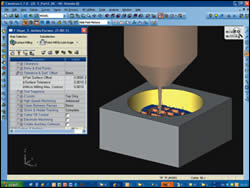
High accuracy micro-milling in a CAD/CAM solution for toolmakers that has a set of easy-to-use 3-D tools.
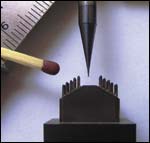
Electrode with 0.1 mm tool. Images courtesy of Cimatron.
If the iPod is any indication, smaller is better. The iPod has become one of the most popular gadgets to ever hit the market, propelling Apple’s profits and stock price to new highs. Not only is the iPod small to begin with, it keeps getting smaller. Replacing the iPod mini is now the smaller iPod nano; and then there is the ever smaller iPod Shuffle.
It is not just the iPod that is getting smaller. Computers and TV displays continue to get thinner. Advances in medical devices enable more and more miniature appliances to be installed inside our bodies; even a tiny camera that can travel through it.


Not only are things getting smaller, they are packed with more components to provide added power and functionality. Miniature components have a wide variety of applications in aerospace, automotive, biomedical, electronics, information technology optics and telecommunication industries.
All of these product developments are increasing the demand for manufacturing of micro-scale components and products. To keep cost down, the vast majority of these micro-components are manufactured using molds. These trends present moldmakers with new and diverse challenges, ranging from the use of new space-age materials to special mold coatings, milling parts with 0.1mm diameter tools and achieving sub-micron-level accuracy.
At the same time, it is the inherent complexity of micro-components that brings about new opportunities for moldmakers. At a time when the production of simple and medium complexity molds is shifting to countries with low labor cost, U.S. and European moldmakers can turn to more advanced technologies such as micro molds and micro milling to maintain their competitive edge.
Machining of Micro-Parts
One of the major challenges in manufacturing molds for micro-components is the machining of miniature parts. Both direct milling of active mold areas and manufacturing of EDM micro-electrodes place extreme demands on the milling process.
Challenges related to micro-milling include the use of miniature tools with diameters down to 100 microns (µm) or even less, spinning at very high speeds of up to 150,000 rpm. Surface quality (Ra) needs to be as good as 0.2 microns. And since polishing is often impractical with such fine parts and micro-details, micro-milling calls for polishless machining.
Micro-Milling Technology
In order to achieve the quality and accuracy required in micro-milling while meeting economic constraints, the entire manufacturing chain must be optimized and synchronized. Vendors of CNC machines, cutting tools, holders, clamping tools and quality control equipment are all required to provide the right solution at a competitive cost.
Following is a checklist of the major issues that should be addressed in a micro-milling environment:
1) Cutters, Holders and Spindles
- Small-sized cutters are the enablers of micro-milling. Depending on job size, they can be as small as 0.1mm, and will probably get even smaller in the future. Availability and cost of cutters must be considered before committing to a micro-milling project.
- While using small cutters, high-speed spindles are critical. A spindle with 10,000 rpm and 0.1mm cutters means a cutting feed (Vc) of only 3.3 m/min—this is much too slow!
- With rpm levels at 20,000-150,000, a fully balanced combination of spindle and shrink holders, with zero runout, is a must; otherwise, surface quality will be compromised and tool life will be dramatically shortened.
2) Fixtures, Clamping Systems and Manufacturing Processes
- In most cases, the production of micro-milling parts should be done with a single setup. For example, combining EDM and milling would likely result in unacceptable mismatches and marks.
3) Machine and Shop Floor
- It goes without saying that the machine must be consistently accurate and sensitive to the fourth decimal digits (mm controller).
- Micro-milling can make good use of five-axis milling. The ability to tilt a tool away from the material enables using shorter tools. However, since continuous five-axis milling is currently less accurate than three-axis milling, machine specifications and actual performance must be carefully validated when using continuous five-axis for micro-milling.
- Machine environment must have a controlled temperature (software compensation might not be enough) and free from vibrations. If the machine is not properly isolated, even a heavy truck that passes outside the facility might generate enough of a vibration to leave its marks on the surface.
4) Milling Technology
- Depending on part geometry, micro-milling might require special machining strategies that go beyond simply scaling everything down. In many cases, for example, conventional milling (and not climb milling) would be the preferred milling strategy.
Requirements of CAD/CAM systems
Everyone intuitively understands that milling machines, holders and tools are difficult to scale down to the microscopic dimensions and extreme accuracy needed for micro-milling. At first glance, software might seem to be an easier fit. After all, one might claim, working with a number like 0.0001 should be just as easy for the software as working with 1.0 or 10.
But there is more here than meets the eye. Creating and modifying geometry with the right accuracy, smoothness and continuity are just the entry points for a micro-component CAD solution. In order to have a functional solution for micro-milling, the CAD systems must be carefully tuned and optimized to support the following requirements:
- Read the part model reliably and accurately. Minimizing the need for multiple data conversions is critical for maintaining accuracy of the detailed model.
- Work with tight geometric tolerances of 0.1-0.01 microns when generating parting surfaces or creating geometry for sliders, lifters and ejectors. This is essential in order to prevent gaps between surfaces and to keep C1 and C2 continuity.
- Handle multicavity molds of very small sizes, including specialized catalog parts and assemblies.
CAM systems also must be optimized for micro-milling. NC software must handle the tight tolerances and ultra-accurate machining. And since the operator cannot interfere to prevent tool breakage, the NC software must accurately consider the chip load throughout the machining process.
To adequately support micro-milling, the CAM software should be able to:
- Accurately utilize the highly detailed mathematical model, while maintaining its level of complexity. Having an integrated CAD/CAM solution is ideal, since it eliminates any data translations in the process.
- Include high-accuracy, built-in CAD capabilities within the CAD system that can provide assisting geometry (e.g., capping, extending surfaces, etc.) with the appropriate accuracy and tangency within the CAM system.
- Support toolpath calculation with tolerances down to 0.1micron. This is especially challenging when machining miniature details in large size parts.
- Support calculation with micro-milling level parameters considering the constraints of the physical machines. For instance, the CAM system may be required to provide super-finish results with a tool diameter of 0.1mm, a side step of 0.005mm and a 10 times large round corner radius of 0.05mm. Toolpaths must be created accurate to the fifth decimal point.
- Support machining strategies optimized for micro-milling, such as the machining of rough, re-rough and finish in the same NC operation.
- Use the knowledge of actual remaining stock throughout the entire process to adjust feed to actual tool load in order to lower machining time while protecting the delicate tools from breaking.
Summary
Micro-system, micro-molds and micro-milling are new and exciting technologies for the mass manufacturing of miniature parts. With sub-micron tolerance and tool tips that can hardly be seen by the naked eye, this emerging and fast-growing field presents numerous challenges to moldmakers and vendors. New materials, new tools, special mold coatings and innovative CAD/CAM software techniques all have to be studied and mastered.
On the bright side, micro-systems and micro-milling bring about new opportunities for moldmakers who are seeking to differentiate themselves, generate more business and be better positioned against lower-wage competitors.
Effective development of this field requires cooperation between industry, academy and government. Such collaboration is already underway in Europe. The European Union’s Cooperative Research Action For Technology (CRAFT) project brings together The Fraunhofer Institute for Production Technology (IPT) and leading vendors in CAD/CAM, CNC machines, tools and clamping to develop the next age of materials, machines, software tools and working methodologies for micro-manufacturing. It is time for the North American tooling industry to join in the effort to develop this emerging high profile and lucrative market segment.


Related Content

Free Injection Molding Training, Hands-On Demonstrations
Visit RJG’s booth at the K Show to watch training segments from its trainers worldwide, receive hands-on demos of the CoPilot system and view the power of The Hub networking system.
Read More
Tackling a Mold Designer Shortage
Survey findings reveal a shortage of skilled mold designers and engineers in the moldmaking community, calling for intervention through educational programs and exploration of training alternatives while seeking input from those who have addressed the issue successfully.
Read More
MMT Chats: American Mold Builders Association on Best Practices for Employee Attraction and Hiring
MoldMaking Technology Editorial Director Christina Fuges sits down with AMBA’s Managing Director Kym Conis and the Director of Strategic Execution Rachael Pfenninger to discuss its Employee Attraction and Hiring Playbook and the Workforce Development Task Force. This episode is brought to you by ISCAR with New Ideas for Machining Intelligently.
Read More
MMT Chats: California Mold Builder Discusses the Difficulties with Silicone Molding and the Power of the Magic 8 Ball
MoldMaking Technology Editorial Director Christina Fuges sits down with M.R. Mold President and Owner, Rick Finnie, to discuss how he began his moldmaking career, M.R. Mold's LSR Education, and the struggles of working with silicone. This episode is brought to you by ISCAR with New Ideas for Machining Intelligently.
Read MoreRead Next

Micromoldmaking: It’s a Small World After All
A great deal of attention needs to be paid to the design and build process—as well as post-moldmaking processes—when making molds for tiny parts.
Read More
How to Use Strategic Planning Tools, Data to Manage the Human Side of Business
Q&A with Marion Wells, MMT EAB member and founder of Human Asset Management.
Read More
Are You a Moldmaker Considering 3D Printing? Consider the 3D Printing Workshop at NPE2024
Presentations will cover 3D printing for mold tooling, material innovation, product development, bridge production and full-scale, high-volume additive manufacturing.
Read More